The 2026 MyrtleBeachGolfTrips.com Intercollegiate provided Coastal Carolina with an opportunity to celebrate a championship at Grande Dunes Resort Club, but the three-day event also gave golfers planning a Myrtle Beach trip something they don’t often get — a statistical look at how every hole on the course performed under tournament conditions.
With 90 players competing over 54 holes, the Intercollegiate generated 4,860 individual hole scores. Thanks to scoring data powered by Clippd, those numbers provide an intriguing look at where Grande Dunes challenged the field, where birdies were plentiful and which holes demanded the most respect.
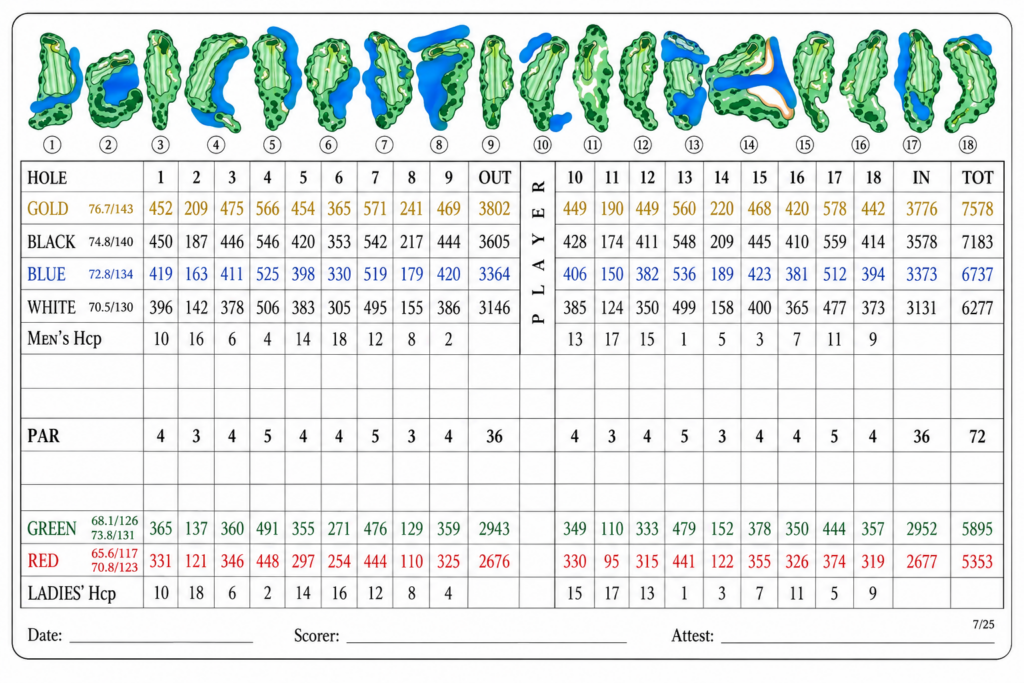
There is an important distinction for vacationing golfers: the Intercollegiate was played from 7,578 yards, considerably longer than the tees most players will choose during a Myrtle Beach golf trip.
But that’s also part of what makes the numbers interesting. The yardages may change, but many of the challenges presented by the course remain.
Here’s what three days of tournament golf taught us about Grande Dunes.
(Grande Dunes Scorecard at the bottom of this story for reference)
No. 3 Was the Toughest Test of the Week
If there was one hole that consistently gave the college players trouble, it was the 475-yard par-4 third.
No. 3 played to an average of 4.46, making it the most difficult hole at Grande Dunes by a comfortable margin.
Across 270 scores, players recorded just 17 birdies. On the other side of the ledger were 86 bogeys and 26 scores of double bogey or worse.
Put another way, nearly 42 percent of the field’s trips through No. 3 resulted in bogey or worse, while birdies occurred just over 6 percent of the time.
Vacationing golfers won’t be asked to tackle the hole from 475 yards, but the message remains the same: par is a score you’ll happily take on No. 3.
Grande Dunes Saves One of Its Toughest for Last
Getting to the clubhouse with your scorecard intact isn’t guaranteed.
The 442-yard par-4 18th finished as the second-hardest hole of the tournament, playing to an average of 4.29.
Only 24 birdies were made there over three rounds, compared with 69 bogeys and another 15 scores of double bogey or worse.
It’s an appropriate conclusion to a round at Grande Dunes. No. 18 provides the type of memorable finish golfers expect at one of Myrtle Beach’s premier courses, but the Intercollegiate numbers show the finishing hole has plenty of bite as well.
If you’ve got a good round going as you walk to the 18th tee, there is still work to do.
Want a Birdie? No. 13 Was the Place to Find One
If No. 3 represented the week’s biggest challenge, No. 13 was at the opposite end of the spectrum.
The 560-yard par 5 was the easiest hole during the Intercollegiate, producing a remarkable 4.42 scoring average — 0.58 strokes under par.
Players made 152 birdies and 11 eagles on No. 13. There were only 15 bogeys and just one score of double bogey or worse.
More than 60 percent of all scores on the hole were birdie or better.
Of course, college players possess the length to attack a 560-yard par 5 in a way most recreational golfers can’t. Move forward to an appropriate set of tees, however, and the lesson is still applicable: No. 13 is one of the places to be aggressive if you’re looking to make up a shot.
The Par 5s Were Grande Dunes’ Scoring Holes
No. 13 wasn’t an outlier.
One of the clearest trends from three days of competition was how much success players enjoyed on Grande Dunes’ four par 5s.
The 571-yard seventh was the second-easiest hole, yielding 113 birdies and four eagles while playing to a 4.67 average.
The 566-yard fourth averaged 4.88, while the 578-yard 17th played to 4.90.
That means every par 5 at Grande Dunes played under par for the tournament.
For golfers preparing to play the course, it’s worth remembering. There are plenty of places at Grande Dunes where protecting your score should be the priority. The par 5s, particularly when playing a suitable set of tees, offer some of the day’s best opportunities to give yourself a realistic look at birdie.
Don’t Underestimate the Par 3s
The par 3s presented a very different challenge to the Intercollegiate field.
All four played over par, led by Nos. 8 and 14, which each averaged 3.27. No. 2 played to 3.15, while No. 11 averaged 3.09.
The listed tournament yardages for the four par 3s ranged from 190 to 241 yards, though the tees were moved throughout the three-day event and not every hole played to its full listed distance each round.
For visiting golfers, who will typically play these holes from more accommodating yardages, the numbers still offer a useful preview. Grande Dunes’ par 3s demand attention, and simply finding the putting surface can be a very good outcome.
Where Else Did Grande Dunes Fight Back?
Behind Nos. 3 and 18, two more lengthy par 4s were among the course’s most demanding holes.
The 454-yard fifth and 468-yard 15th each played to an average of 4.28, tying for the third-most difficult scoring average of the tournament.
No. 5 produced 75 bogeys and 13 doubles or worse, while No. 15 accounted for 77 bogeys and 10 doubles or worse.
Add in Nos. 8 and 14, the two long par 3s that averaged 3.27, and a pattern begins to emerge: when Grande Dunes asked the field to handle length while still executing precise shots, even accomplished college players had difficulty consistently beating par.
A Course That Gives You Chances — But Makes You Earn Them
Perhaps the most interesting thing about the numbers is the contrast.
Grande Dunes isn’t a golf course where every difficult hole arrives in one stretch or every scoring opportunity is confined to another.
The front nine features the tournament’s toughest hole at No. 3, but golfers soon encounter scoring opportunities on the par-5 fourth and seventh.
On the back nine, the field found birdies in bunches at No. 13. The par-4 16th also played under par at 3.86, followed by another opportunity at the par-5 17th.
Then comes No. 18, the second-hardest hole of the week.
It’s a rhythm that rewards golfers who recognize when it’s time to attack and when par is a very good score.
What Does It Mean for Your Round?
Nobody booking a Myrtle Beach golf vacation should look at these numbers and expect to duplicate the experience of a Division I golfer playing Grande Dunes from 7,578 yards.
That’s not the point.
Instead, nearly 5,000 competitive hole scores provide a unique road map of the Resort Course.
They tell us that No. 3 deserves your attention early. They show that the par 5s can provide opportunities. They warn you not to dismiss the par 3s. And they make it clear that no matter how well the day has gone, Grande Dunes has one more challenge waiting at No. 18.
Coastal Carolina left Grande Dunes with the 2026 MyrtleBeachGolfTrips.com Intercollegiate team championship.
For the rest of us, the tournament left behind something almost as useful: a preview of where to attack, where to be cautious and what to expect the next time we tee it up at Grande Dunes.
Photos for this feature from MyrtleBeachGolfTrips Instagram Account